





Choosing a ceramic kiln is an essential step for any ceramic artist, whether a beginner, hobbyist, or professional. Today, there are many models suited to a wide range of uses: pottery, sculpture, glass, metal enameling, and industrial production.
Each type of kiln has its own characteristics, advantages, and applications. Your choice will depend primarily on your practice, the desired production volume, the required firing temperatures, and the space available.
In this guide, discover the main types of ceramic kilns, their specific features, and the major brands available from Ceradel.
Top-loading kilns
Top-loading kilns, also known as vertical kilns, are the most common models in ceramic studios.
Their top opening optimizes floor space while providing excellent firing uniformity. Thanks to their cylindrical chamber, heat is distributed evenly, making them perfectly suited for firing earthenware, stoneware, and porcelain.
They are particularly popular with individuals, schools, associations, and craft studios.
Advantages
• Excellent heat distribution
• Small footprint
• Wide range of capacities
• Excellent value for money
• Suitable for most ceramic applications
Front-loading kilns
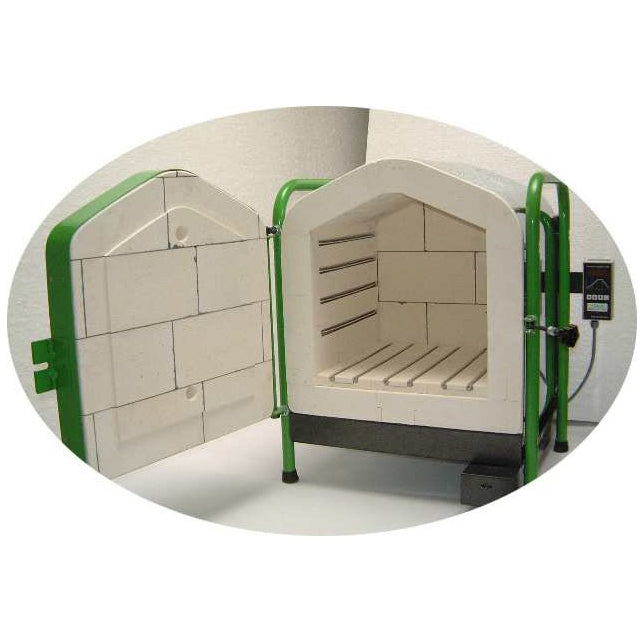
Front-loading kilns open via a door at the front, providing direct access to the entire firing chamber.
This design makes loading pieces much easier, especially when they are heavy, bulky, or fragile. It is also easier to arrange the kiln shelves and access the different levels.
These kilns are widely used in production studios, schools, community centers, and training facilities.
Advantages
• More ergonomic loading
• Easy access to pieces
• Ideal for large creations
• Excellent ease of use
• Suitable for frequent firings
Raku and gas kilns
Raku kilns are specially designed for Raku firing, a Japanese technique involving removing pieces from the kiln while they are still glowing hot and placing them in a combustible material to create reduction effects.
Unlike electric kilns, they run on gas, allowing for rapid heating and better control of the firing atmosphere.
They are also used for certain techniques requiring reduction firing or direct intervention during firing.
Advantages
• Fast heating
• Oxidizing or reducing atmosphere
• Ideal for Raku firing
• Great creative freedom
Fusing kilns
Fusing kilns are designed for working with glass.
They allow multiple layers of glass to be fused at high temperatures to create decorative objects, jewelry, plates, panels, sculptures, or architectural elements.
Thanks to their highly precise programming, they are also suitable for slumping, thermoforming, and annealing techniques.
Advantages
• Perfectly controlled temperature
• Glass-specific programs
• Excellent firing precision
• Ideal for glass creations
Kilns for enameling on metal
Kilns for enameling on metal are designed to fire enamels applied to various metal substrates, such as copper, silver, or steel.
Compact and highly responsive, they quickly reach the required temperatures while providing excellent thermal stability.
They are primarily used by jewelers, enamel artists, craftspeople, and specialized educational institutions.
Advantages
• Very fast heating
• High precision
• Compact format
• Low energy consumption
Top-opening kilns
Top-opening kilns have a heating section that lifts vertically while the kiln floor remains fixed.
This design provides full access to the firing chamber and makes loading the largest or most fragile pieces considerably easier.
They are particularly popular for sculpture, glass, molds, and all large-scale projects.
Advantages
• Very convenient loading
• Safe handling of large pieces
• Excellent access to the entire firing surface
• Perfect for large-scale works
Industrial kilns
Industrial kilns meet the needs of businesses, laboratories, technical centers, and educational institutions with intensive operations.
They stand out for their large volumes, robustness, and extensive customization options.
Depending on the application, they can be used for ceramics, glass, heat treatment, technical materials, or industrial processes.
Advantages
• Very large capacity
• Intensive use
• Many possible configurations
• High control precision
• Long-term reliability
Major kiln brands available from Ceradel
At Ceradel, we select manufacturers recognized for the quality of their equipment, their reliability, and their expertise in ceramic and glass firing.
Rohde
Originally from Germany, Rohde is a leading name in the ceramics world. The brand develops high-performance kilns for both individuals and professionals. It is particularly renowned for its innovations in thermal insulation and energy efficiency, with ranges such as Ecotop and TE-S.
Nabertherm
A world leader in industrial and craft kilns, Nabertherm offers one of the most comprehensive ranges on the market. Its equipment meets the needs of ceramic artists, glass artists, laboratories, schools, and industrial users. Its manufacturing quality and control precision make it an international benchmark.
Kittec
A German manufacturer, Kittec designs robust, easy-to-use kilns that offer excellent value for money. Its equipment is particularly popular with schools, community centers, production studios, and ceramic artists seeking reliable, durable equipment.
Cesame
A French manufacturer, Cesame develops kilns for the ceramics and glass industries. Recognized for their manufacturing quality and reliability, Cesame equipment meets the needs of both craftspeople and educational institutions.
Essential equipment for using a ceramic kiln
In addition to the kiln itself, several accessories are essential for achieving high-quality firings and protecting your equipment.
Kiln shelves
Kiln shelves support pieces during firing. Available in different sizes and thicknesses, they help optimize kiln loading.
Kiln posts
Kiln posts allow multiple shelves to be stacked, making full use of the kiln's height. They are available in many heights to accommodate different piece sizes.
Pyrometric cones
Pyrometric cones allow you to check the actual amount of heat received by pieces during firing. They are an excellent supplement to electronic controllers.
Kiln shelf protectors
Kiln shelf protectors prevent enamels from sticking to the kiln shelves and extend their lifespan.
Heating elements
Heating elements are the kiln's heating components. They naturally wear out over time and must be replaced when heating times become abnormally long.
Thermocouples
The thermocouple measures the temperature inside the kiln and transmits the information to the electronic controller. It plays an essential role in firing precision.
Gloves and safety accessories
High-temperature gloves, kiln tongs, and protective equipment allow you to handle pieces and accessories safely, especially during Raku firings.
How to choose the right kiln for your practice?
The best kiln is, above all, the one that suits your activity.
• Do you practice pottery? A top-loading or front-loading kiln will be perfectly suited for firing earthenware, stoneware, and porcelain.
• Do you create sculptures or large pieces? A top-opening kiln will make loading and handling considerably easier.
• Do you work with glass? Choose a fusing kiln with specific programs.
• Do you want to practice Raku? A gas kiln is essential for this technique.
• Are you looking for equipment designed for intensive production? Industrial kilns will meet the needs of professional studios, laboratories, and educational institutions.
Whatever your project, Ceradel supports you with a wide selection of Rohde, Nabertherm, Kittec, and Cesame kilns, as well as all the essential accessories for installing, using, and maintaining your equipment. Our specialists are available to help you choose the model best suited to your needs, budget, and skill level.